

Home > Tips and Facts > Gray Iron Casting Design > Rule 10
Avoid Using Bosses, Lugs, and Pads
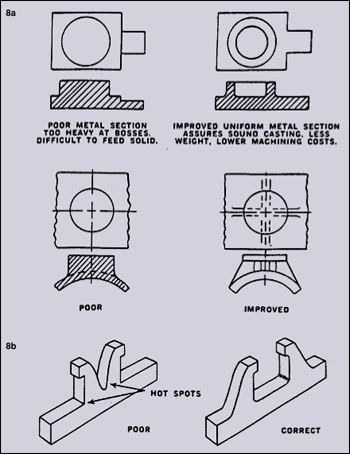
Bosses and pads increase metal thickness, create hot spots and cause open grain or draws. If they must be incorporated into a design, blend them into the casting by tapering or flattening the fillets.
Bosses should not be used in casting design when the surface to support bolts may be obtained by milling or countersinking. In addition, a continuous rib instead of a series of bosses will permit shifting hole location.
The thickness of bosses and pads preferably should be less than the thickness of the casting section they adjoin but thick enough to permit machining without touching the casting wall. Where a casting section is light and does not permit this, following these minimum recommended heights can serve as a guide:
- if the casting length is less than 1.5 ft, the height of the boss should be at least 0.25 in.;
- if the casting is 1.5-6 ft, the boss should be at least 0.75 in.;
- if the casting is more than 6 ft, the boss should be 1 in. When there are several lugs and bosses on one surface, they should be joined to facilitate machining.
When there are several lugs and bosses on one surface, they should be joined to facilitate machining. A panel of uniform thickness (instead of many pads at varying heights) will simplify machining. In large castings, pouring a metal section that is too heavy at the bosses is difficult to feed. A better design is to make the walls of the boss at uniform thickness to the casting walls (Fig. 8a - 8b).
Fig. 8a - 8b: By designing a uniform metal section at the boss (essentially removing unnecessary material at the center of the boss), both weight and machining costs are reduced. In addition, to avoid heat concentration, spread lugs.
Communication Ensures Optimized DesignThe one rule that covers every stage of good design is communication. While there are rules that govern how gray iron will solidify and take shape as a cast component, each casting process will affect the metal differently and will offer its own benefits. Before issuing a final drawing, it’s imperative to consult a foundry team or patternmaker. The engineer must know how to design a casting that will actually have the requisite strength and functional properties, while a foundry team must be able to make the casting so that it has the strength and functional properties the engineer intended. From a foundry point-of-view, it is more important to receive a component design that is practical and efficient than a "perfect" design that cannot be produced commercially without structural weakness. Consultation will permit consideration of foundry problems that are likely to be encountered and will promote casting soundness. The time and cost of manufacture also should be considered in the preliminary stages of casting design. Important questions a foundry team can answer are:
|
Previous: << Rule 9. Maximize Design of Ribs and Brackets

If you would more information about Atlas Foundry Company and the Gray Iron Casting and other services we provide, please call us at (765) 662-2525, fill out our Information Request Form , or email Sales.