

Home > Tips and Facts > Gray Iron Casting Design > Rule 7
Fillet All Sharp Angles
Fillets (round-ed corners) have three functional purposes:
- to reduce the stress concentration in a casting in service;
- to eliminate cracks, tears and draws at reentry angles;
- to make corners more moldable by eliminating hot spots.
The number of fillet radii in one pattern should be the minimum possible, preferably only one. To fulfill engineering stress requirements and reduce stress concentration, relatively large fillets may be used with radii equaling or exceeding casting section. Fillets that are too large are undesirable—the radius of the fillet should not exceed half the thickness of the section joined.
To avoid a section size that is too large at an "L" junction, round an outside corner to match the fillet on the inside wall. Where this is not possible, consideration must be given to which is more vital: the engineered design or the possible casting defect.
In the case of a "V" or "Y" sections and other angular forms, always design them so that a generout radius eliminates localization of heat.
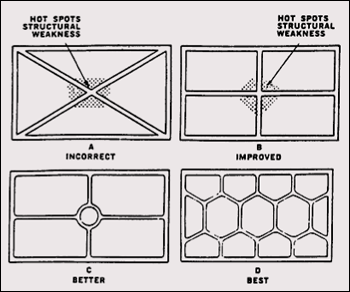
Fig. 7a - 7d: In 7a, walls meet at acute angles, creating hot spots. The best design is 7d in which honeycombing produces uniform cooling conditions, assuring improved strength with minimal risk of distortion and structural weakness.
Next: Rule 8. Avoid Abrupt Section Changes >>
Previous: << Rule 6: Correctly Proportion Inner Walls

If you would more information about Atlas Foundry Company and the Gray Iron Casting and other services we provide, please call us at (765) 662-2525, fill out our Information Request Form , or email Sales.